Sunday, 13 May 2012

Fati's story....obstetric fistula surgery

Fati’s story
Fati has 4 children. All were born without any problems, but her fifth child was different. He got stuck. Slowly, painfully, she laboured for 4 days. Her husband found someone to help take her to the nearest hospital, several hours drive from their village. But the hospital turned them away. Fati and her husband did not have the money to pay for the caesarean section she needed. They tried another hospital, and another. But each time the story was the same. No money, no treatment. They became desperate so they lied. They told the fourth hospital they could pay for a caesarean section and so Fati was admitted. Her baby had long since died, but at least her suffering was over, or so she thought. She and her husband sneaked out of the hospital the very next morning before it was light. They ran away because they couldn’t pay. Fati noticed the wetness immediately, but she thought it would heal up as her body recovered from the ordeal. But it persisted. The wetness made her skin sore, but worse, a stench of stale urine became her constant companion. It was overpowering. Her husband left her and people in the village shunned her. She became an outcast, and relying on people’s pity and scraps of food thrown to her, like dog. Her life had changed beyond anything she could imagine. She existed, but wished she didn’t. She had no hope. Fati contemplated suicide. Fati has a vesicovaginal fistula (VVF).
Obstetric Fistula – medical details
A fistula is a hole, or abnormal connection between two structures. Obstetric fistulas (of which VVF is one type), are caused by obstructed labour and lack of access to obstetric care In obstructed labour the fetal head causes unrelenting pressure on the pelvic structures, damaging them severely. The bladder, urethra, vagina, uterus and rectum can all be damaged. The tragedy is that obstetric fistulas are totally preventable by access to appropriate obstetric care, which is why we don’t see or hear of them in the ‘west’. Moreover, there are few ‘western’ surgeons who specialise fistula surgery because there is minimal need.  But here in Africa, among the poorest of the poor, the need is great indeed.
Mercy Ships
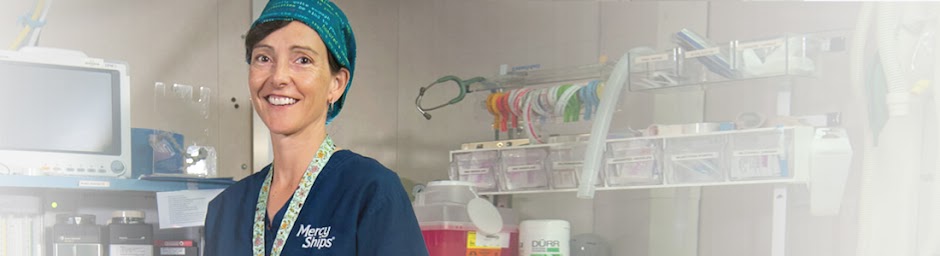
I have just spent the last month working with Dr Lauri Romanzi, a fistula surgeon from the US. We have performed just under 50 fistula repairs, and trained a Togolese surgeon, Dr Sewa in both spinal anaesthesia and repair of simple VVF’s. Some of the fistulas we encountered were complex, difficult cases and we worked late into the evening many times to help all the women who were scheduled for treatment. Women with fistula suffer from a huge loss of dignity and self-worth. One of the wonderful things about fistula surgery onboard the Africa Mercy is that it doesn’t just treat the body but also the soul. The women receive a new dress and gifts when they are discharged which signify a restoration of dignity, identity, significance and self-worth. This is a time of celebration. There is dancing and many women share their stories. It is a moving occasion and we call it the ‘Dress Ceremony’.
Togo, Niger, and Ethiopia
Togo has recently made caesarean sections free of charge to all women. That is a huge step forwards in fistula prevention. The next step is to train more surgeons / medical officers /anaesthetists to perform spinal anesthesia and caesarean section, and improve access to these facilities. In the meantime, we will continue to train doctors like Dr Sewa to help his people and we will continue to need facilities like Danja Fistula Centre in Niger.
Danja Fistula Centre in Niger is a fistula hospital which officially opened earlier this year. It was built and is partially funded by The Worldwide Fistula Fund. A friend of mine, Sarah Walker, who used to be nurse on Mercy Ships, now helps run the hospital. They are short of anaesthetists. So anyone wanting to help for a few weeks to a few months would be most welcome.
One of the biggest Fistula hospitals in in Addis Ababa, Ethiopia. A fascinating history of this hospital, and more insight into the lives of women suffering from VVF is given in the book, ‘A hospital by the river’ by Dr Catherine Hamlin. Dr Hamlin has been describe as a ‘modern Mother Teresa’.

You and me
How will you be described?
How do you want to be described?

Wednesday, 11 April 2012

Introducing Darius

Darius is a 9 year old boy who comes from Cotonou. Cotonou is the capital city of the neighbouring country, Benin.
Today is Easter monday, and two weeks ago I met Darius. His eyelids had fused together last year and he came to have surgery to literally ‘open his eyes’. I don’t know why his eyes had fused together. But that didn’t matter. Here was a little boy, sat in front of me, who once could see but now was blind.
Sometimes making a diagnosis can be difficult in medicine. Doctors are like detectives, piecing together the clues to come up with a ‘who dunnit list’ of possible culprits. Most clues come from what the patient tells us. Examining the patient gives more information, creating a list of possible suspects (diagnoses). Finally, tests and investigations confirm or refute our suspicions.  Like most mysteries, the solving is best done when the evidence is fresh. Trying to figure out what happened years later is much more difficult. That was the situation with Darius.
Darius had been a healthy boy until last year. He enjoyed school and playing with his friends. Then, like many children his age, he caught chicken pox. Because he was malnourished the chickpox became a severe infection. What happened next is unclear. His mother thinks he had a severe allergic reaction to an antibiotic which caused his skin to peel especially around his lips and eyes. His eyes swelled so much he couldn’t open them. When the infection healed it fused his eyelids together so he couldn’t open them. A once happy boy, now sat quietly on the edge of his bed, head hanging down. 
But there was a small glimmer of hope. Darius could distinguish bright light from darkness. That meant it was worth surgically opening his eyes to see if the eyes themselves were damaged. There was a chance Darius might be able to see.
So we literally cut open Darius’s eyes. The left eye was badly damaged, but the right eye less so. More treatment was necessary. Darius would have to come to surgery every day to have his eyes cleaned and cared for under general anaesthetic. The surgery would be painful, requiring large doses of morphine. A tough ordeal for a frightened 9 year old, in a foreign country.
Over the last 2 weeks, there have been ups and downs. Initially Darius made good progress but then the progress slowed and he needed eye drops every hour. We were praying, his mum was praying. She stayed up all night praying when his eyes took a turn for the worse.  She has made a big sacrifice for her son. She has travelled to another country, leaving her other children behind, just to give this son a chance for sight. Darius is that precious. She doesn’t know when her son’s ordeal will end. Nor does she know if it will be worth it. Will Darius ever see again? I don’t know. I hope so, but his treatment continues.
As doctors, we do what we can. We wait patiently. Here on the ship we also pray. His mum does the same. She puts her son’s needs before her own. What parent wouldn’t?
This reminds me of Easter. The bible says God is our heavenly  father. As our dad, God also made a sacrifice for us. Just like Darius’s mum made a sacrifice.
God sacrificed his only son so we could be forgiven. God cares for you and me, just like Darius’s mum cares for him. Darius is precious to his mum. You and I are precious to God.  A parent will do whatever they can to help their child. God wants to help us too. He wants to hold our hand, in his nailed pierced hands and walk life’s journey with us. What parent wouldn’t?
This Easter, do you know how precious you are? Will you take God's hands offered for you?

Happy Easter Darius. See you in surgery tomorrow.

Tuesday, 13 March 2012

I don’t understand…. but I do believe

My computer is connecting wirelessly to a satellite connection in outer space and allowing me to post this blog for you to read. I don’t really understand how it all works. I can’t see the internet, and I can’t explain all the science behind wireless satellite communication, but some people can. I don’t need to be able to explain it for it to happen. It is a reality. No doubt some of you reading this can explain all the science, but most of us can’t. We just know it is a reality.
Now, I don’t know if you believe in God, but my experience this month tells me someone is out there, and that someone is listening, and actually wants to talk to me. Let me share a couple of stories that happened to me in the last few weeks since my last blog post (the first 2 are from Benin and the 3rd is from this first week on the ship).
1.       In Texas, we were told we were going to Benin to work in 3 areas: a prison, an orphanage, and building a wall. We also had the names of some of the individuals we would be working with. We asked God if there was any individual in particular that we should pray for. God told us to pray for individual ‘D’.  We then asked God how we should pray for ‘D’. He told us a few things about how she was feeling, and some specific things that had been troubling her. We then asked God which of our team members should try and connect with ‘D’. God said team member ‘M’. So we prayed about that these two individulas would connect and that ‘M’ would have the opportunity to encourage ‘D’. We arrived in Benin and on the very first day we went to the orphanage. At lunchtime ‘D’ was sitting down and beckoned for ‘M’ to join her. They chatted and ‘M’ shared we had been praying for ‘D’, but did not say what we had prayed for. ‘D’ said ‘thank you so much’ and then proceeded to share with ‘M’ how she had been feeling and what was troubling her. It was exactly the same things that God had showed us in prayer.  And ‘D’ said that in the last few weeks things had gotten a bit better. That was the time we had started praying.

2.       We were also practicing this type of ‘listening to God’ prayer before each visit to the prison. We did this as adults and with some of the children in our team who were 7 and 9 years old. We would say: ‘God tell us what you want us to say in the prison’.  We would ‘listen’ for a few minutes and then share what we felt God had spoken to us. Then we would pray those things. One night one of the children was reminded of a story called ‘Footprints’ (click on the page tab above to read this short story). This story tied in with some of the words and impressions that the adults felt God was saying. So we prayed. Then the night before we went into the prison God woke one of us up in the middle of the night with an African version of the ‘Footprints’ story. The next morning we went in to the prison and told the story to the women. Many of these women wept as they listened to the story.  That was something new, they hadn’t done that on previous occasions when we visited. You could feel the presence of God in the place and I believe God spoke to the women through the story we shared. Many of the women were in prison because they had been accused of witchcraft or sorcery. Others were there for simple theft offences.

3.       The eye team on board ship have been very short staffed and the staff we do have are inexperienced. So it has been a difficult start to the work. A friend of mine who is a new member of the eye team wanted us to pray in the eye room, so we did. God also spoke to her about praying specifically in that room. So she obeyed and went to the eye room before work on Monday and Tuesday . On those days there was an atmosphere of peace and even the surgeon (who knew nothing about the prayers) commented on the calmness in comparison to the week before. On Wednesday the lady decided to pray for the day from her cabin rather than actually in the eye room itself. That day things seemed more chaotic than the previous days, and what’s more, many of the patients had problems with high blood pressure. High blood pressure is common as the patients are anxious but it can cause the surgery to be cancelled. The next day, Thursday, the lady returned to the eye room to pray, and the calm atmosphere returned, and there were no problems with blood pressure.
Coincidences?
Maybe. But maybe it is something more….
I don’t know if you believe in God, but my experience this month tells me someone is out there, and that someone is listening, and wants to talk to you.
Just like the internet, I don’t understand prayer …..but I know it works and I am trying to use it.
‘Surely the Sovereign Lord does nothing without revealing his plan to his servants the prophets.’ Amos 3: 7
Now….. if God exists, then that is exciting.

Sunday, 12 February 2012

BTS and Screening

While I was undergoing Basic Safety Training (BST) in Texas, friends on board were screening approximately 4000 adults and children in Togo. Approximately about 1500 patients are booked for life-transforming surgeries in the operating room. Thousand more will undergo dental and cataract surgeries as well.

The video (see right) shows footage of the screening.

More photographs of screening can be viewed by clicking on the above tabs, as can photos and video of the basic safety training - fire fighting and sea survival.

All done here in Texas, leave for Africa tomorrow....33 hours and 4 flights later we will be in Benin....and then 20 days later we arrive in Togo to join the ship....can't wait. Next blog post will be from on board the Africa Mercy.

Tuesday, 31 January 2012

Change

It has been a month of change.
I have been in Texas for 3 weeks at the Mercy Ships International Operations Centre (IOC) undergoing a period of training before I join the ship.
I have changed where I live, who I hang out with, what time I eat dinner. The clothes here are different – Texas is boots and bling. The cars, the roads, the food portions are different. All BIGGER.
We have classes from 8 till 4.30 weekdays, plus some Saturday and evening sessions. Assignments to hand in every week. It is a change from giving anaesthetics and working on intensive care.
‘So far so good’.  Or perhaps I should write with less of the British reserve and say something more American such as ‘So far it’s TOTALLY AWESOME’.  Yes, there are cultural differences and realising they exist is one of the things we have been learning. I have experienced cultural differences through working and travelling to many places overseas. But until now I had little understanding of why those differences existed, or the prejudices that most of us unconsciously hold. Many of us are unaware of how our view of the world impacts our thoughts and actions. I am learning to change the way I think about the world. This is essential if I am to make any lasting impact in West Africa especially with regards training healthcare providers.  
Understanding other cultures starts with understanding our own culture and ourselves. I teamed up with another Brit to present some of the British cultural values – see picture. We’ve also spent time understanding ourselves through personality assessments. I can’t change my personality but I can change the way I interact with others. This will help me bring out the best in them.
There has been a lot of change, or as I like to call it, realignment. My faith has been challenged, my view of the world expanded and adjusted. Realignment.
Change is not a bad thing. It is often necessary. If I need to sail on a bearing of 1800 to reach my destination, but I am just a tiny bit off, say 1810. After a while I will be way off target and may miss my destination altogether. The sooner I realise, the easier and quicker it is to make an adjustment, a necessary correction. Realignment.
So I am grateful for the realignment, minor corrections and adjustments to my ways of thinking. We all need it from time to time. But sometimes we are too proud to admit it. The only person who doesn’t need correction or realignment is God. He is totally consistent. He never changes. Africans have the phrase ‘God is good all the time. And all the time God is good’.  So I thank God for His goodness and His consistency in times of change.
Every good and perfect gift is from above, coming down from the Father….who does not change like shifting shadows.  James 1:17

Tuesday, 27 December 2011

10 days and counting

10 days to go and I am almost ready…. almost…..
I have almost finished work. I have almost completed my list of administrative tasks. I have almost finished saying final goodbyes to friends and family. I have almost started packing…..but not quite !
This month I have been overwhelmed at people’s generosity and support in numerous ways. Work colleagues have voiced their appreciation and affirmation of what I do in the medical world; friends and family have said how much they value me and will miss me; and many of you have prayed specifically for me and given financially. I am truly grateful for all the love and encouragement I have received. There’s been something quite humbling about this last month.  
Humbling – yes. Why? Because I am aware that I don’t have a right to people’s support, but I do need it. Acknowledging that I actually need help and then seeing it so generously provided is actually quite a humbling experience.  
In the 21st century we are brought up to be independent and self-reliant. So the idea of relying on someone or something else to provide for our needs takes a bit of getting used to. We are also brought up to work hard so we deserve our achievements.  So giving up my job and financial security, leaving behind emotional attachments to family and friends, so I can volunteer on a ship in Africa seems to turn this view upside down. Or does it?
I am reliant on others to support and provide for me. The concept that I don’t deserve it, I don’t have a right to it yet I still need it, reminds me of Christmas. God sent His son into the world because we needed Him. Jesus offers to support and provide for us. We don’t deserve it, but the gift is given. Receiving the gift requires humility (or meekness). The carol, O little town of Bethlehem puts it like this:
How silently, how silently,
    The wondrous gift is given;
So God imparts to human hearts
    The blessings of His Heaven.
No ear may hear His coming,
    But in this world of sin,
Where meek souls will receive Him still,
    The dear Christ enters in.


So, thank you for your kind support and generous provision which has been a tangible reminder of the meaning of Christmas.
Only 10 days to go…..I’m almost ready ……. but I’d better start packing.

Tuesday, 29 November 2011

Preparation – joy or hassle?

‘How’s your preparation going?’

That was the question I was asked by a colleague the other day.

What was my response?

I think preparation consists of two aspects, social and administrative. I love the social. Time spent with friends and family before I leave is a total pleasure. However, the administrative aspect produces other emotions. Hassle, and a sense that much effort is required to do everything I need to do before I leave. The list of tasks is endless.....sorting out my house, my car, various professional licensing issues, change of address notifications, booking flights, filling in numerous forms, deciding what to pack and what to leave behind. It feels like it’s constantly one thing after another.

There is so much to do and so little time to do it. But I don’t want my last few weeks in England to be defined by ‘effort and hassle’. I want to enjoy them. So I’ve decided to do just that. I believe you can change how you think because the bible says you can, and I have seen it to be true in my own life. ‘Don’t copy the behaviour and customs of this world, but let God transform you into a new person by changing the way you think’. (Romans 12: 2). I’m learning to change how I think.

I can’t control what needs to be done or what might happen to me. But I realise I can control how I react to external things. It is choice and I can choose. I’m choosing to think joy and peace not hassle and effort. I am choosing to enjoy all the little jobs that need doing. And I’m refusing to let anything or anyone to rob me of my joy. And how do I do that? By applying another biblical principle,‘Don’t worry about anything; instead pray about everything. Tell God what you need, and thank Him for all he has done. Then you will experience God’s peace, which exceeds anything we can understand. His peace will guard your hearts and minds as you live in Christ Jesus’. (Philippians 4: 6-8). That's how.

So, what was my response to the question, ‘How’s the preparation going?’

‘Great thanks. I’m really enjoying my last few weeks.’